
Mayberry, N.C., has more in common with its northern counterpart, Lake Wobegone, Minn., than the fact that both are fictional pop culture icons.
Garrison Keillor’s Lake Wobegone, where “all the children are above average,” has spawned what educational academics bemoan as the Lake Wobegone effect, the illogical situation in which more schools score above average than below in standardized evaluations. (http://psychology.wikia.com/wiki/Lake_Wobegon_effect)
In a like manner, Mayberry has given the world what could be called the Barney Fifing of the American Student.
Barney Fife As a Role Model
Like students today, Barney could never be 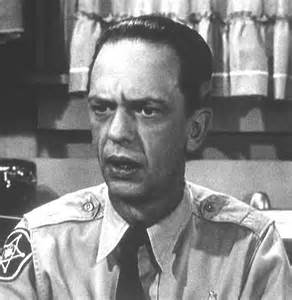 criticized. Andy was always there, correcting Barney’s errors (frequently without his knowing it), building Barney’s ego, and thereby preventing Barney from growing up.
Remember when Barney tried to sing? Rather than explain that he could still be a wonderful human being even though he had an atrocious singing voice, Andy hooked up a ringer to sing for Barney. Thus for the rest of his life, he probably annoyed Mayberry residents with his off-key attempts.
Remember when Barney tried to arrest a shoplifter, but neglected to follow procedure? Barney wouldn’t listen to Andy’s explanation of due process, even though he had spotted the correct culprit. Thus in the future, other criminals might continue to get away with crimes because Barney refused to learn.
Remember when Barney tried to memorize a state law? Andy fed him every word, and when he was done, Barney grinned like he had it. He didn’t.
The Benefits of Criticism and Failure
The American Student is being treated the same way. Rules, procedures? Damaging to the creative spirit. Failures? Damaging to the ego. Errors? Well, what is an error anyway? After all, there are alternate realities.
Just like Barney, however, students are being hurt by this over-protection.
Rules and procedures actually do serve a purpose sometimes. A student is given an application for a scholarship to fill out with specific directions. When they’re not followed, the application isn’t set aside, it’s thrown out.
Failures? Students today are not allowed to fail, to be completely wrong, to be totally off the track. But what do we learn from failure? We learn that success is even sweeter, that we can do it, we can overcome our own shortcomings. Students who are not allowed to fail are denied the true joy of succeeding.
And errors? Errors can cause real problems. Perhaps it is important, in a research paper about the problems couples face who can’t have children, to address marital infertility, not infidelity. Perhaps it is important, in trying to generate interest in Big Brothers and Big Sisters, not to label the group as Big Bothers.
The Real World
What happened to Barney when he left Mayberry and Andy’s protective shield? In defying an order, did he get shot, or foil an arrest? In not knowing police procedure, did he allow a criminal to get away with murder?
When our students leave college today and enter the “real world,” what happens to them when they find being careless or making errors has consequences, and that no one will be around to clean up after them?
Just as Andy was doing Barney no favor, we are doing our students no favor in protecting them from themselves. Life is not a sitcom. There is not always a happy ending at the end of 30 minutes.
What we need is the Opie-fying of the American Student. Andy never let Opie get away 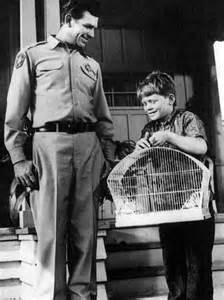 with anything. Remember Opie’s becoming mama to the baby birds whose mother he had killed by accident? When Opie made a mistake, he had to own up to it and make it right. He learned respect and compassion — and how to work for his rewards.
And wouldn’t we all rather live in a world of Opies than a world of Barneys?
— 30 —-
 -- 30 --