Math Part 2. Why time flies.

Each fall, Beloit College in Wisconsin issues its Mindset List, used to describe the incoming class of freshmen, and help others relate to their life experiences. After teaching for 30 years, I find each list more terrifying.

Especially when I compare it to my own college freshman mindset.

Pearl Harbor and World War II both occurred before I was born, so as a 20-year-old student, they were not a part of real life. World War I and the Civil War were out of history books.

For today’s 20-year-old student, comparable events are, in order, the Challenger explosion (didn’t that just happen?), Rosa Parks refusing to move to the back of the bus, and the first flight of the Wright brothers.

Seriously, the first flight is as far back to today’s student as the Civil War is to me.

It’s often a moment of shock to me when students don’t get a reference, especially when it’s something I think of as current, like a Seinfeld quotation. They used to say, “My mom liked that”. Now they are saying, “My grandma liked that.”

794c062f-c889-3ec5-9be7-d7c75e14ae97            Freshmen today were not even born when the X-Files premiered.

The X-Files.


When looking at the Beloit list, I’ve often thought the saddest will be the year, soon coming, when no college freshman lived in a time that did not include 9-11. Terror-alert chart and Homeland Security will always have been a part of their world.

A math professor once explained to me this is all a matter of ratio. People who are 50 find a year goes by quickly, but not so for a child who’s 5. That’s because a year is 2% of the adult’s life but 20% of the child’s. I guess that’s also why, when I think of the past 30 years of my life, it seems like many lifetimes – being a young(ish) woman, working in different careers, getting an education, preparing for retirement. But when I think about the next 30, should I be blessed to live so long, it seems like a blink of the eye.

Today I look back and think I should have enjoyed my health more when in my 40s and 50s. When I’m 80, will I think of 65-year-old Julie as being a kid?




Posted in Uncategorized | Tagged , , | Leave a comment

Math Part 1. What do you do all day?

Sometimes when I tell people I teach three classes, they will then assume that I work part-time. Or they’ll ask me what I do all day.

For me, three classes means 11-12 hours a week in the classroom. Assuming that is part-time is like assuming Aaron Rodgers works four hours a week.

Teaching itself is only one of a professor’s three main duties: teaching, research and service. That’s pretty standard across the country, not just in Wisconsin.

Here are some numbers.

Let’s say I spend two hours for each hour in the classroom preparing (that number is much higher) which includes: researching the topic, reading the textbook assignment, preparing the lecture, creating the assignments, grading the assignments, writing and grading the exams, preparing handouts, updating information, and more. That brings us to 33 hours per week.

How much time is spent interacting with students? How different that is today than 30 years ago. At that time, there was the telephone – and students would rarely call me at home during off hours (midnight to 8 a.m. weekdays and all day weekends). Now there is email – 24/7.

Then there is meeting with students about job and internship opportunities, writing letters of recommendation, responding to calls about references (for students from last year, 5 years ago, 10 years ago), advising a student group, advising students individually, discussing classroom and personal problems. Let’s call that five hours a week (again, very low ball estimate). Now we’re to 38 hours per week. And my guess is most parents would feel this should be a significant part of my time.

Professors are also supposed to provide service to four levels: the department, the university, the community and the profession. All faculty serve on committees, many of which are extremely time-consuming, such as searches for new hires, examining curriculum to keep it relevant and affordable, and so on to infinity. I recently spent a weekend creating a teaching module for a national organization. So let’s call this 3 hours a week (again, way low). We’ve passed 40 hours.

But much of what tenure, promotion, and raises are based on involves creating new knowledge, or research. This could be creating a national survey, assembling results, analyzing and writing, then finding a publisher or a conference at which to present. Or it could be a book chapter. Or a whole book, textbook or other. Or new media. Or writing a play or piece of music or finding a new species, depending on the department. All this activity comes after the 41-hour week.

Then there are duties difficult to categorize. I get about 200 emails a day, some of which are requests from students, some of which are list servs that help keep me up to date. I can’t read a newspaper or magazine without clipping out something I will use in class. The past several years, I’ve spent countless hours getting our program certified, and petitioning to have the public relations emphasis made into a major.

And then there is summer. People often envy professors for having summers “off”. The only thing we have off during the summer is a paycheck. Faculty members are expected to continue all of their duties during the summer – why else would meetings be scheduled?

In reality, most surveys show faculty work between 50-60 hours per week. The discrepancy between perception and reality is based on the fact that we get to choose which 60 hours. Just drive by your local campus at any time or day. I’ve been in my office working on Christmas Day, Easter, at 4 in the morning – and I’ve never been in the building alone.

We’ve had many adjunct professors in our department, that is, professional people who teach one class on the side. Without exception, each one has said the same thing at the end of the semester – “I didn’t think it would take so much time.”

Nobody does.

Posted in Uncategorized | Tagged , | Leave a comment

The Barney Fifing of the American Student


Mayberry, N.C., has more in common with its northern counterpart, Lake Wobegone, Minn., than the fact that both are fictional  pop culture icons.

Garrison Keillor’sth-2 Lake Wobegone, where “all the children are above average,” has spawned what educational academics bemoan as the Lake Wobegone effect, the illogical situation in which more schools score above average than below in standardized evaluations. (http://psychology.wikia.com/wiki/Lake_Wobegon_effect)

In a like manner, Mayberry has given the world what could be called the Barney Fifing of the American Student.

Barney Fife As a Role Model

Like students today, Barney could never be thcriticized. Andy was always there, correcting Barney’s errors (frequently without his knowing it), building Barney’s ego, and thereby preventing Barney from growing up.

Remember when Barney tried to sing? Rather than explain that he could still be a wonderful human being even though he had an atrocious singing voice, Andy hooked up a ringer to sing for Barney. Thus for the rest of his life, he probably annoyed Mayberry residents with his off-key attempts.

Remember when Barney tried to arrest a shoplifter, but neglected to follow procedure? Barney wouldn’t listen to Andy’s explanation of due process, even though he had spotted the correct culprit. Thus in the future, other criminals might continue to get away with crimes because Barney refused to learn.

Remember when Barney tried to memorize a state law? Andy fed him every word, and when he was done, Barney grinned like he had it. He didn’t.

The Benefits of Criticism and Failure

The American Student is being treated the same way. Rules, procedures? Damaging to the creative spirit. Failures? Damaging to the ego. Errors? Well, what is an error anyway? After all, there are alternate realities.

Just like Barney, however, students are being hurt by this over-protection.

Rules and procedures actually do serve a purpose sometimes. A student is given an application for a scholarship to fill out with specific directions. When they’re not followed, the application isn’t set aside, it’s thrown out.

Failures? Students today are not allowed to fail, to be completely wrong, to be totally off the track. But what do we learn from failure? We learn that success is even sweeter, that we can do it, we can overcome our own shortcomings. Students who are not allowed to fail are denied the true joy of succeeding.

And errors? Errors can cause real problems. Perhaps it is important, in a research paper about the problems couples face who can’t have children, to address marital infertility, not infidelity. Perhaps it is important, in trying to generate interest in Big Brothers and Big Sisters, not to label the group as Big Bothers.

The Real World

What happened to Barney when he left Mayberry and Andy’s protective shield? In defying an order, did he get shot, or foil an arrest? In not knowing police procedure, did he allow a criminal to get away with murder?

When our students leave college today and enter the “real world,” what happens to them when they find being careless or making errors has consequences, and that no one will be around to clean up after them?

Just as Andy was doing Barney no favor, we are doing our students no favor in protecting them from themselves. Life is not a sitcom. There is not always a happy ending at the end of 30 minutes.

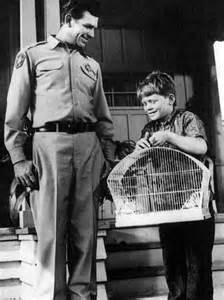
What we need is the Opie-fying of the American Student. Andy never let Opie get away th-1with anything. Remember Opie’s becoming mama to the baby birds whose mother he had killed by accident? When Opie made a mistake, he had to own up to it and make it right. He learned respect and compassion — and how to work for his rewards.

And wouldn’t we all rather live in a world of Opies than a world of Barneys?

— 30 —-


Posted in Uncategorized | Tagged , , , , | Leave a comment

Pay Attention

Woody Allen supposedly once said that 80 percent of success in life is showing up. I’d add, showing up and paying attention.

Most journalism students here are aware of Jim VandeHei, co-founder of Politico.com in 2007. His photo is on the Alumni Awards Wall of Fame. He is the only journalism graduate to have earned an honorary doctorate. And he’s the only UW Oshkosh graduate to be impersonated on Saturday Night Live.

Jim’s last semester at UW Oshkosh overlapped my first. He took one class from me.

My class was a perfect storm for creating monster senioritis. Jim was coming from a summer spent at a successful internship in Washington D.C. He had a job waiting for him there once he graduated; the class was outside of his emphasis; and he had a professor still getting used to the class, the department and the campus.

So what did he do in my class? He listened. He contributed. He put effort into the assignments. He worked hard enough to get an A.

Jim VandeHei isn’t successful because he took one class from me, but I do believe he is successful because of the way he took the class. I suspect he approached it the way he approaches every person and every situation: as an opportunity to learn something new. Just like other successful people do.

I often hear complaints from students about classes they find boring or pointless. But it’s possible to learn something during every experience. As I tell my students, even listening to my boring lectures can train them to focus, which will be a good skill once they start attending staff and committee meetings.

So pay attention. Especially in public relations, you never know when information about the rocks of Wisconsin or 18th Century French poetry may come in handy.

Posted in Uncategorized | Tagged , , | Leave a comment